Dogs Communicate Through Their Whole Body
When people try to understand a dog, they often look only at the tail. But a wagging tail does not always mean that a dog is happy.
To understand what a dog is communicating, it is important to look at the whole dog rather than focusing on just one signal.
Pay attention to:
- Ears
- Eyes
- Mouth
- Tail
- Body posture
- Movement
- Distance from people
- Changes in behaviour
One signal on its own may not tell the complete story. A dog wagging its tail while keeping its body stiff and avoiding interaction may be feeling very differently from a dog with a loose body, soft eyes, and relaxed movements.
The best approach is to observe the dog’s overall posture and behaviour. Give the dog enough space to communicate in its own way and allow it to decide whether it wants to come closer.
Understanding the whole body helps us respond more safely and respectfully, creating better interactions between people and dogs.
What Does a Relaxed Dog Look Like?

A relaxed dog usually has a loose, natural posture.
You may notice:
- A relaxed body rather than a stiff one
- Naturally positioned ears
- Soft or normal-looking eyes
- A relaxed mouth
- Natural tail movement
- Normal breathing and movement
- An interest in its surroundings without appearing overly alert
A relaxed dog may choose to approach a person, but it may also simply continue resting, walking, or doing its own thing.
The important point is that a relaxed dog does not necessarily want to be touched.
Allowing the dog to make that choice is part of respectful interaction.
Signs That a Street Dog May Be Uncomfortable
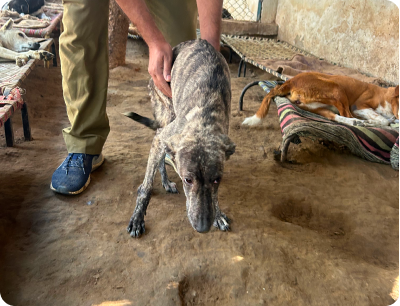
Dogs can become uncomfortable when they feel threatened, crowded, surprised, or unable to move away.
Some signs can include:
- Turning the head away
- Avoiding eye contact
- Lowering the body
- Moving away from people
- Licking the lips
- Yawning in an unfamiliar situation
- Holding the ears back
- Keeping the tail low or tucked
- Becoming unusually still
These signs do not mean that a dog is “bad” or “aggressive”.
Often, the dog is simply communicating:
“I am uncomfortable. Please give me some space.”
This is why recognising early signs of stress can be so important. Giving a dog distance before it feels more threatened can help prevent a situation from escalating.
What If a Dog Becomes Stiff or Gives a Warning?
Sometimes a dog may become very still or stiff.
It may:
- stare directly
- hold its body rigid
- show its teeth
- growl
- bark in a warning manner
- try to make itself appear larger
- move away while continuing to watch the person
These are signals to stop moving closer.
Do not punish, corner, chase or try to force physical contact with a dog that is warning you.
Instead, create distance and allow the dog an opportunity to move away.
A growl is communication. It is valuable information that tells us the dog is uncomfortable enough to ask for more space.
Never Assume That a Wagging Tail Means “Friendly”
One of the most common misunderstandings about dogs is that a wagging tail always means happiness.
It does not.
Tail movement needs to be considered along with the dog’s entire body.
A relaxed dog may have a loose, natural tail movement. A frightened or highly aroused dog may also move its tail, but its body, ears, eyes and posture may tell a very different story.
So instead of asking:
“Is the tail wagging?”
ask:
“What is the whole dog telling me?”
This simple change in observation can help people understand dogs more accurately.
How Should You Approach an Unfamiliar Street Dog?
If you meet a street dog you do not know, the safest approach is to avoid rushing toward it.
Give the dog space
Do not crowd, corner or chase the dog.
Observe before approaching
Look at the dog’s body posture and behaviour before deciding whether interaction is appropriate.
Avoid sudden movements
Move calmly and allow the dog time to understand your presence.
Do not force contact
If the dog moves away, let it.
Be especially careful around puppies
A mother dog may become protective when she believes her puppies are at risk. Children should never approach puppies without appropriate adult guidance.
Do not disturb a dog while it is eating or sleeping
A dog that is resting or protecting food may feel threatened if someone suddenly enters its space.
The safest interaction is often the one where the dog is allowed to remain comfortable.
Teaching Children to Understand Dogs
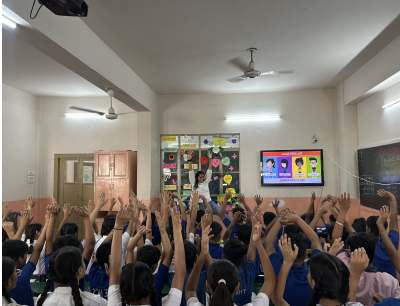
Children and street dogs share the same neighbourhoods, schools, parks and public spaces. Helping children understand dog behaviour can therefore make a real difference.
This is one of the reasons Help in Suffering’s Humane Education Programme includes “Speaking Dogese / A World for All”, a module that teaches children to understand dog body language, reduce fear and learn safer interactions with dogs. HIS says its programme uses interactive workshops, visual aids, roleplay and real-life learning to build empathy and responsible behaviour.
What children can learn
Children can be taught to:
- recognise signs that a dog is comfortable or uncomfortable
- avoid chasing or teasing dogs
- give animals space
- understand that barking does not automatically mean a dog wants to attack
- avoid disturbing dogs while eating or sleeping
- ask an adult for help when they find an injured or distressed animal
- respond calmly rather than running towards an unfamiliar dog
HIS’s recent annual report recorded 9,500+ children reached across 45+ schools in Jaipur during July 2024–August 2025, with reported engagement and knowledge-retention results from the programme.
Understanding Dogs Can Also Help Prevent Bite Incidents
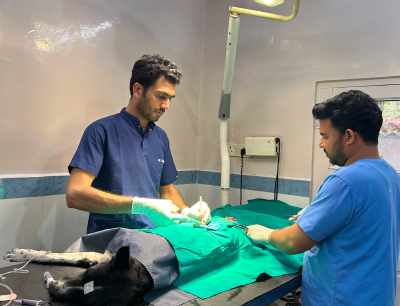
Learning dog body language is one part of creating safer communities. Long-term prevention also involves vaccination, sterilisation, responsible community practices and public education.
Help in Suffering has worked on Animal Birth Control (ABC) and vaccination in Jaipur since the 1990s, alongside its wider animal welfare and public health work. HIS also maintains a research and resources section covering dog population dynamics, rabies control and dog-bite studies.
Research associated with the Jaipur programme provides an important example of why long-term, evidence-based interventions matter.
An ICAM summary of an economic analysis covering 1994–2017 reported that the Jaipur ABC programme was associated with an estimated 360,000+ dog bites averted and nearly 500 human rabies deaths averted over that period, based on comparisons with a counterfactual scenario. These are historical research estimates, not current-year figures.
Separate research presented by HIS researchers found that the incidence of human dog bites in Jaipur fell from 7.2 per 1,000 people in 1993 to 2.2 per 1,000 in 2018, based on independently collected government hospital data. The authors discussed possible links between dog breeding patterns, maternal behaviour and bite incidence.
This research does not mean that every dog bite can be explained by one cause. Rather, it highlights why understanding dog behaviour, preventing fear-based interactions and supporting evidence-based population and vaccination programmes all have a role to play.
What Should You Do If You Find an Injured or Distressed Dog?
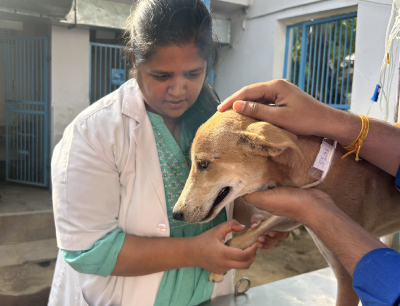
Sometimes a dog does not need someone to approach it—it needs professional help.
You may find a dog that has:
- been hit by a vehicle
- suffered a serious wound
- become unable to walk
- been badly injured in a fight
- been abandoned
- become severely ill
- been trapped or unable to move safely
In these situations, avoid putting yourself or the animal at greater risk.
Keep a safe distance, move people away from the animal if possible, and contact an appropriate animal rescue service for guidance.
Help in Suffering provides emergency rescue and veterinary services for animals in Jaipur and surrounding areas. Its current website lists a 24×7 rescue/helpline service and provides
+91-8107299711 as its current contact number.
Need Help for an Injured or Distressed Animal in Jaipur?
Help in Suffering Rescue Helpline
📞 +91 81072 99711
If you see an animal in serious distress in the HIS service area, contact Help in Suffering for guidance.
Please do not put yourself at risk or attempt to physically restrain a frightened or severely injured animal unless you have been advised and know how to do so safely.
Understanding Is the First Step Towards Coexistence
Street dogs are part of the communities they live in.
When we understand their signals, we can respond differently. Instead of assuming that a frightened dog is aggressive, we can recognise fear. Instead of approaching a dog that is asking for space, we can step back. Instead of ignoring an injured animal, we can know when to seek help.
That is the value of learning street dog body language.
It is a small skill, but it can change the way people and animals share the same streets.
At Help in Suffering, this understanding is part of a wider approach that combines rescue, veterinary care, Animal Birth Control, vaccination, research and humane education.
Because safer communities begin with understanding.

Learn More from Help in Suffering
- Humane Education & Community Outreach
- Rescue & Rehabilitation
- Animal Birth Control & Vaccination
- Evidence & Research
- Get Involved
Help in Suffering (HIS)
Maharani Farm, Durgapura, Jaipur, Rajasthan, India
Rescue Helpline: +91 81072 99711

 A street dog may not be able to tell us what it is feeling in words, but it is communicating all the time.
The position of its ears, the movement of its tail, the way it holds its body, where it looks, and even how close it chooses to stand can tell us a great deal.
Learning to understand street dog body language is not just about getting closer to animals. It is about knowing when to give a dog space, when an interaction is safe, and when a dog may be frightened, stressed, or in need of help.
For people and dogs who share the same streets, this simple understanding can make everyday interactions safer and more compassionate.
A street dog may not be able to tell us what it is feeling in words, but it is communicating all the time.
The position of its ears, the movement of its tail, the way it holds its body, where it looks, and even how close it chooses to stand can tell us a great deal.
Learning to understand street dog body language is not just about getting closer to animals. It is about knowing when to give a dog space, when an interaction is safe, and when a dog may be frightened, stressed, or in need of help.
For people and dogs who share the same streets, this simple understanding can make everyday interactions safer and more compassionate.