
 What the camels go through to reach Pushkar
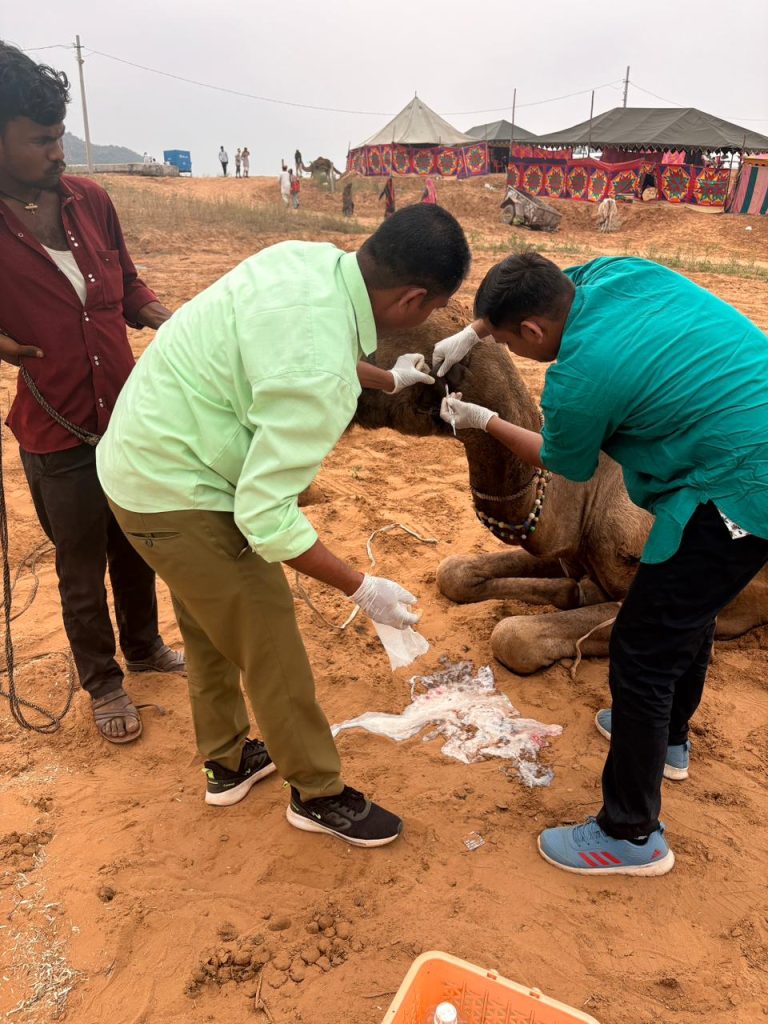
Camels are remarkable animals – resilient, patient, built for desert endurance. But the journey to Pushkar tests them beyond what they are designed to bear. Owners walk their animals for days across Rajasthan, often without adequate rest or water. Others load them onto trucks for transport, where the stress of confinement, sudden temperature changes, and rough roads takes its own toll.
By the time they arrive at the fairgrounds, many camels are already suffering. In 2025, our team treated 637 camels over seven days. The conditions we commonly see include:
Every camel that arrives at our camp receives free treatment. This year, our vets also distributed 690 plastic nose pegs – a humane alternative to the traditional wooden ones – dewormed 300 camels, and fixed safety reflectors on 510 camel carts to prevent the nighttime road accidents that are a leading cause of camel deaths on Rajasthan’s highways.
 The Pushkar Camel Fair: more than a market
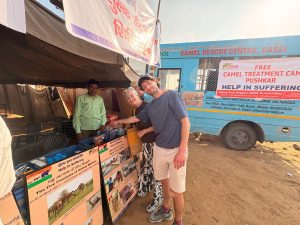
The Pushkar Camel Fair is one of the world’s largest camel fairs, and it is among the oldest livestock trading events in Asia. Held on the banks of the sacred Pushkar Lake, roughly 150 kilometres from Jaipur, the fair draws traders, herders, tourists, and pilgrims. At its peak in the 1990s, it was the largest gathering of camels on the subcontinent.
Today, the fair has changed. Once defined by thousands of camels traded between Rajasthani herder families, it now attracts more tourists than traders. This shift reflects something deeper: India’s camel population is in freefall.
India’s single-humped camel, the Camelus dromedarius, has been a part of Rajasthan’s landscape for thousands of years. The state declared the camel its official state animal in 2014, a recognition of how deeply the species is woven into Rajasthan’s identity. But that recognition came just as the population collapse was accelerating.
The causes are intertwined: mechanisation replaced the working camel as tractors and motorcycles arrived in rural Rajasthan; traditional grazing land was swallowed by development; legislative changes restricted camel trade across state borders, inadvertently removing the economic incentive that kept breeding viable. The Raika community – the hereditary camel herders of Rajasthan, who have cared for these animals for generations – found their traditional livelihood no longer sustainable.
The United Nations recognised the severity of this global crisis by designating 2024 as the International Year of Camelids. For India, where the once-million-strong camel population has shrunk by over 85%, the urgency is acute.
The Pushkar camp is the most visible part of HIS’s camel welfare work, but it represents only one week of a programme that runs 365 days a year. Since launching our Camel Welfare Programme in 2001, we have built what is now the only sustained, species-specific camel healthcare service in Rajasthan.
“When we first began, most camel owners viewed their animals purely as working tools. Today, I see many of the same owners recognising their camels as sentient beings deserving proper care. The transformation in attitudes has been as important as the veterinary work itself.” – Timmie Kumar, Managing Trustee, Help in Suffering |
Our work runs across three areas:
Our specially equipped mobile clinic reaches working camels across Jaipur and the surrounding rural belt six days a week. For a camel owner whose animal can’t work, every day of illness is a day without income. We reach communities where the nearest veterinarian has no experience treating a camel – because almost no veterinarians in India do. Over 25 years, we have treated more than 1,22,000 camels through this programme.
 The Camel Rescue Centre, Bassi
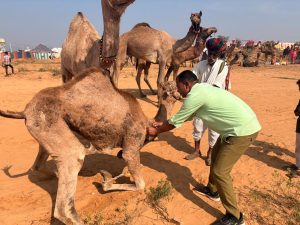
In 2011, with support from the ELSU Foundation in Switzerland, we established India’s first dedicated camel hospital in the village of Bassi, 30 kilometres from Jaipur. The Camel Rescue Centre (CRC) admits camels that are too seriously injured or ill to remain with their owners – animals that have been abandoned, rescued from trafficking, or left behind when their working days ended.
Among the animals who have found sanctuary at Bassi:
Treatment camps at Pushkar, Nagaur, and Jaisalmer
Beyond the annual Pushkar camp, our team runs treatment camps at the Nagaur cattle fair and at Jaisalmer, where camels used in desert tourism receive care they would otherwise have no access to. These camps are where the scale of unmet veterinary need is most visible.
Cumulative impact of the HIS Camel Welfare Programme, 2001–2025:
Source: HIS internal programme records, 2025. Only 2 road traffic accidents involving camels recorded since reflectors were introduced.
 Why this work matters beyond welfare
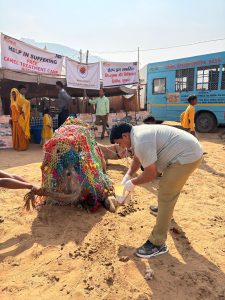
Camel welfare is not only about individual animals. Camels are the livelihood of some of Rajasthan’s most economically marginalised communities. When a working camel gets sick, a family loses its income. When the camel population collapses, entire communities face poverty.
At the same time, the camel is a remarkable ecological species – drought-adapted, low-input, and sustainable in arid environments where other livestock cannot survive. Protecting camel populations is also protecting Rajasthan’s biodiversity and its desert cultural heritage.
The decline from over a million camels to fewer than 1.5 lakh in four decades is not inevitable. But reversing it requires consistent, on-the-ground healthcare combined with community education and policy change. This is exactly what the HIS Camel Welfare Programme has been building, one treatment camp at a time, since 2001.